Showing posts with label Labor Day. Show all posts

Tuesday, September 5, 2017

Getting the Working Class Right

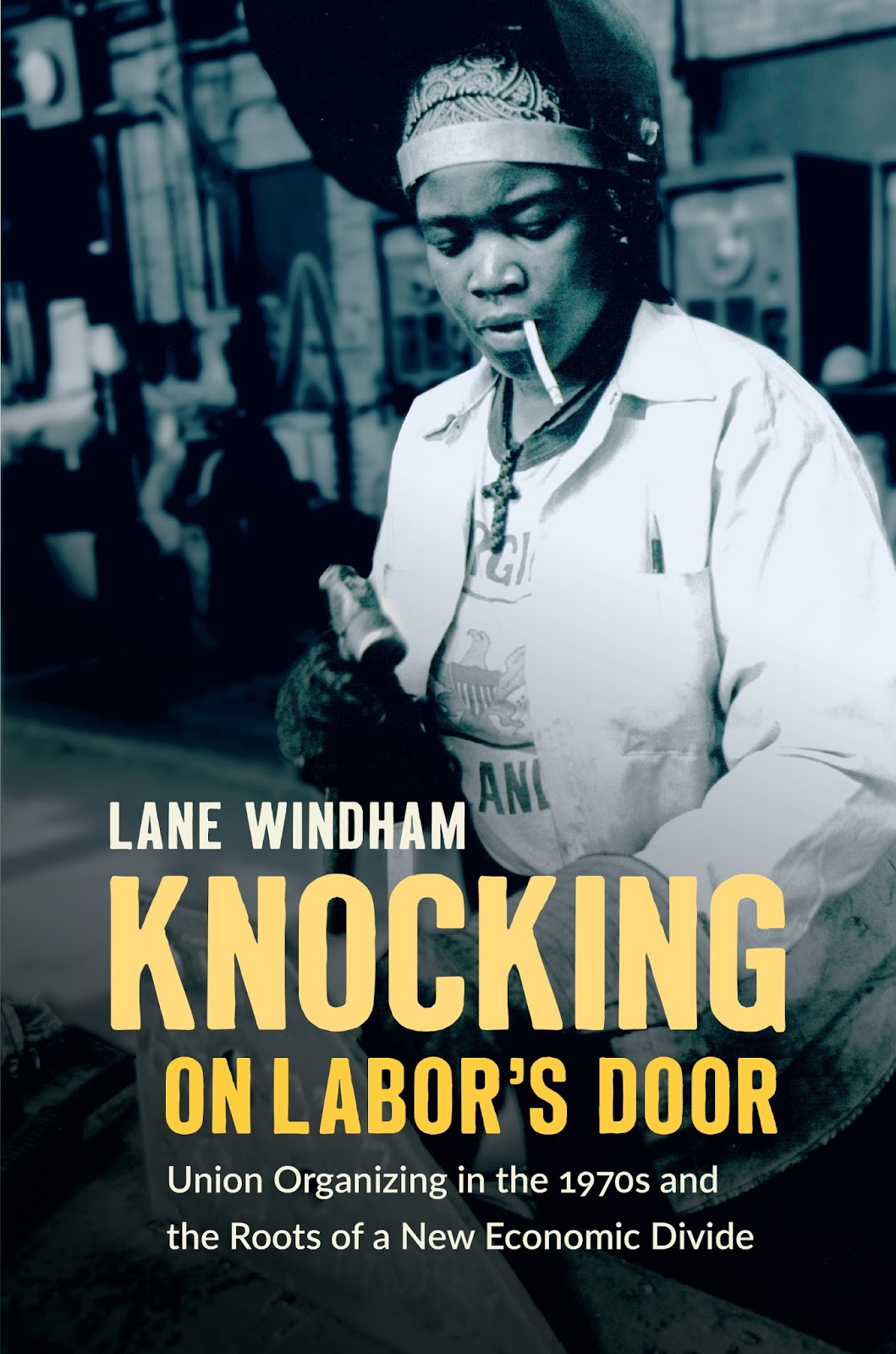
The below Washington Post piece ran just as my new book launched on Labor Day: Knocking on Labor's Door: Union Organizing in the 1970s and the Roots of a New Economic Divide Check the book out here.


The Media Still Gets the Working Class Wrong

by Lane Windham

This will be the first Labor Day since America rediscovered its working class – or, more accurately, one part of its working class. If there was any consensus in the aftermath of last November's election, it was that elites had lost touch with working people. Yet ten months later, most commentators still get the working class wrong.

We hear a lot from pundits about working-class white men, conjuring images of blue collars, hard hats and simmering resentments expressed through votes for Donald Trump.

But in reality, America’s working class is largely female and disproportionately black and brown. Service jobs now outstrip those in manufacturing; the jobs with the highest-projected job growth are typically woman-dominated working-class jobs like nursing, home health care and food service. Significantly, the majority of members of the working class do not see President Trump as their defender.

Post-election analysis overlooked both the complexity and creative energy of the nation's working class. Increasingly, working people are organizing a new kind of workers' movement that combines traditional unions with organizations that build worker power beyond the weakened collective bargaining system.

In fact, we may stand on the cusp of a new surge of worker activism unlike any the U.S. has witnessed since the 1970s. Historians have missed that pivotal decade's working-class promise, instead painting it as an era of division and defeat. School busing riots seize center stage in their tale, as do highly visible male construction workers beating up Vietnam War protestors.

This story isn't wholly wrong, but it's incomplete. The focus on a hard-hatted "silent majority" obscures the millions of workers who were part of a newly diversified working class in the 1970s and who actively organized unions. How we understand working people and their politics, both in the past and today, matters deeply for how we perceive the causes and solutions for the nation's economic divide.

White men haven't been the epicenter of the working class since the 1960s. Following the 1964 Civil Rights Act, women and people of color finally gained more access to jobs at the economy's core. Once this diverse group of workers got those jobs, they demanded unions. A half-million working people per year voted in private-sector union elections in the 1970s, pushing for the full economic security that came with a labor contract.
Employers, however, manipulated aging and outdated labor laws to thwart their efforts. Even unionized industrial employers began to resist new organizing in the 1970s, backed by a vastly expanded anti-union consultant industry.

Globalization and mechanization eroded union membership, but so too did the fact that workers couldn't win union representation over employer opposition. In the 1940s, workers won 80 percent of their union elections. By the late 1970s, employers had the advantage, winning more than half of these elections and blocking workers' access to collective bargaining, a key economic equalizer. Union membership has since continued to slide — a mere 6.4 percent of private-sector workers today have a union.

As unions declined, so did our nation's democracy. After all, organized labor devotes tremendous energy and resources to getting voters to the polls. Groundbreaking research by sociologist Jake Rosenfeld reveals that since 1984, election-day turnout among private-sector union members without a college degree has been seven to eleven points higher than that of similar workers who aren’t union members.

Unions also educate their members on economic and political issues, and so counterbalance the temptation among workers to let divisive cultural issues determine their votes. That is especially true among white union members, who tend to vote more conservatively than do union members as a whole. Far fewer working people today are privy to these kinds of workplace conversations than in unions' heyday.

Unions’ shrinkage also fed the nation’s growing economic divide. Researchers find that between one-fifth and one-third of wage inequality is due to the drop in union membership since the 1970s.

Today’s key working-class concern isn't whether Trump saved a few manufacturing jobs in Indiana. The most burning question seems to be off his radar entirely: how can the majority of working people build better lives when jobs are so bad and unions are so weak?

Part-time, poorly-paid jobs are the new norm, especially in the service and retail sector. Workers often find that they are legally considered independent contractors — and therefore unprotected by labor laws — even when they drive the same truck route each day, or sweep the same office floors. Also excluded from labor law protection are the millions in the gig economy. And when “protected” workers try to form unions, employers routinely fire, harass or threaten them.

Yet despite these challenges, America's diverse working class is even now building a new workers' movement, often far outside the media spotlight. It’s different from the twentieth-century labor movement, which consisted of traditional unions alone. Workers today are blending unions with new organizations that experiment with innovative ways to circumnavigate the nation’s broken labor law system.

Women and immigrants lead these worker centers, public wage campaigns and occupation-based organizations, such as the National Domestic Workers Alliance, the Restaurant Opportunities Centers United and the New York Taxi Workers Alliance. Such groups make creative use of public opinion, wage and hour laws and tried-and-true community organizing tactics to rebuild workers' economic security, even within the changed twenty-first-century workplace. Without ever engaging in collective bargaining, New York restaurant workers have used this array of tactics to win sick days, and Massachusetts domestic workers have won a “bill of rights” guaranteeing overtime pay and fair treatment.

Workers still want unions. Witness the upsurge of unionism on university campuses where adjunct faculty, graduate employees and food service workers are all demanding their right to bargain collectively.

Working people also are pioneering entirely new ways to raise wages and win benefits, often leveraging the power of local government. Sixteen states and localities have approved raising the minimum wage to $15 an hour since 2013. San Francisco, Seattle and New York City have all enacted fair scheduling rules to protect certain workers from erratic shifts and insufficient hours. Unions, worker centers and community groups have banded together to buoy these wins.

Much depends on the success of such experiments. In the twentieth century, we learned that healthy democracies require economically secure citizens. For a generation, we have witnessed the erosion of both. This Labor Day, working women and men are increasingly fighting to reestablish a basic economic foothold. Yet their struggle will remain largely invisible to us as long as we fail to see today’s working class in all of its diversity.

Thursday, September 1, 2016

Best Read for Labor Day 2016

Lane Windham

Best Read for Labor Day 2016: Tamara Draut's Sleeping Giant: How the New Working Class Will Transform America (Doubleday, 2016)


Like me, are you bone weary of hearing non-stop news coverage of Donald Trump? Do you roll your eyes when the pundits “discover” the working class at election time, and then groan when you realize that by “working class” they really only mean white guys? Are you itching for an entirely different public conversation?

Tamara Draut’s Sleeping Giant offers a sharp and widely-accessible discussion about the future of America’s working class, and so brings welcome relief in this election season. Her premise is that there is a “new” working class, compared to that of thirty years ago, that is more racially and ethnically diverse, more female and more likely to work in retail and service. Pointing to the Fight for $15 and the Black Lives Matter movement, for example, Draut posits that this “sleeping giant” may be in the beginning of effecting larger social and economic change.

In a swift and conversational style, Sleeping Giant distills much of the current research on inequality, bad jobs, and precarious work, and couples it with original interviews with workers and activists. We learn, for instance, that only five of the thirty fastest-growing U.S. occupations will require a bachelor’s degree; so much for the elite’s insistence that education will be the great leveler. The chapter on the “New Indignity of Work” could serve as an undergraduate primer for perils in today’s economy such as subcontracting, just in time scheduling, franchises and the “1099” independent contractor relationship.

Unlike many in the punditry class, Draut has read her history, and we see the work of Nelson Lichtenstein, Kim Phillips-Fein, and Judith Stein woven in here as she traces how America’s working people became so economically insecure. She tackles the legacy of racial and ethnic exclusion, and correctly finds great hope in the combination of the immigrant workers’ rights, fair wage and racial justice movements of today.

Yet in Draut’s insistence that today’s is a “new” working class with a new level of activism, she ultimately may do the “sleeping giant” a disservice. First, such a framing erases the extent to which people of color and women have long struggled and organized as part of the working class, as wage workers, enslaved people, and through their neighborhoods and families. In the long arc of history, mid-twentieth century steelworkers were anything but normative. Fight for $15 activists are part of a centuries-long struggle against capitalism, and they should benefit from owning that.

Second, Draut misses the major working-class activism of the 1970s. What we are seeing today is not a “new” working class, but a continued reconfiguration of the working class that started in the 1970s and grew from changes wrought by the 1964 Civil Rights Act. As these women of all backgrounds and men of color got new access to the full employment market in the 1970s, they made up a reshaped American working class that organized for more social and economic justice, including by pushing to form private sector unions. Draut covers how employers ramped up their resistance to unions in the 1970s, but somehow skips the decade’s worker’s movements that inspired the corporate resistance. When we re-write the 1970s struggles back into the story, it becomes more clear that today’s labor activists are part of a much longer movement by women and people of color to gain full access to the New Deal’s economic promise, a story that grows more even more rich with the inclusion of new immigrants since 1980.

Despite these omissions, this is a commendable and inspiring book that covers an enormous amount of material in a short space. Do yourself a favor this Labor Day: put down the Washington Post and pick up a copy of Draut’s Sleeping Giant.

Lane Windham holds a Ph.D. in U.S. History and is a fellow with Georgetown University's Kalmanovitz Initiative for Labor and the Working Poor.

Monday, September 1, 2014

Caution: Making a Living While Black

Lane Windham

After the events of Ferguson, I was inspired to write a Labor Day piece about the deep-seated economic divide. It ran in the Baltimore Sun today. The piece is below:

Caution: Making a Living While Black

Though we’ve narrowed the racial divide since the days of segregation, the economic divide between whites and blacks has been remarkably persistent for the last 40 years. We live in a nation in which if you’re black, you likely earn less, have less wealth and are less likely to hold a job than someone who is white. This Labor Day, let’s take a moment to reflect on the dangers of trying to make a living while black in the United States.

We should be shocked by the fact that the unemployment gap between African-Americans and whites is virtually unchanged from that of 40 years ago. If you’re black, you’re still twice as likely as a white person to be unemployed, virtually the same gap as in 1972, according to government statistics. In Baltimore, you’re even a bit worse off, according to a recent study by the National Urban League; the black unemployment rate of 15 percent there is more than double the white rate of 6 percent.

Once employed, working while black is risky behavior. African-American workers are likely to earn less than whites -- black weekly wages are 78 percent of white wages. This affects not only black workers, of course, but entire families. The median family income for America’s black workers is 60 percent of white workers, and in Baltimore, it’s only 54 percent. The wealth gap is even worse. White families tend to have a more forgiving financial cushion to protect them in tough times. They’re more likely to own their homes, for instance, and to have ample savings. The recent recession hit black families hard. Before the recession, in 2007, whites had 4.3 times as much wealth as blacks. By 2010, the white wealth advantage grew to six times that of African-Americans.

There has been progress. A larger percentage of the nation’s well-paid professionals are African-American -- 7.4 percent, up from 5.7 percent in 1990. Still, African-Americans are over-represented in the nation’s worst jobs. Far too many black workers struggle to cobble together a series of low-wage, precarious service jobs in order to make ends meet.

We do have tools that can address our nation’s persistent racial economic divide. First, we can recognize that we need a new social contract for the 21st century, one offering a more secure safety net for workers in the kinds of part-time, low-wage jobs that workers of color are more likely to hold. For instance, we should consider building a more robust federal retirement system and child care reimbursements which workers can access across jobs. In addition, we can build a more rational system to handle unemployment. Most of the Western nations with whom the U.S. competes economically have a federal unemployment system. We have a patched-together state system which covers less than half of the nation’s unemployed, a deficit that disproportionately affects black workers and their families. Finally, we can restore all workers’ freedom to form unions. A union contract helps black workers narrow the racial divide. A black worker with a union made 27 percent more per hour than black workers who weren’t in unions, according the government statistics for 2008 through 2013.

”What does it profit a man to be able to eat at an integrated lunch counter if he doesn’t earn enough money to buy a hamburger and a cup of coffee,” Dr. Martin Luther King, Jr. asked Memphis strikers and labor supporters in 1968, days before his death. Baltimore was among the first segregated cities in the nation to desegregate public accommodations, opening up lunch counters and restrooms in March of 1960. Yet today, too many of the city’s -- and the nation’s -- African-Americans still lag behind economically. King knew that racism and violence take many forms, and are found in far more places than the end of a gun. This Labor Day - - especially as we begin to parse the full meaning of the recent events in Ferguson, Missouri - - we should carefully consider how to remedy the injury inflicted by our nation’s unremitting racial economic divide.

Lane Windham is a PhD candidate in U.S. history at the University of Maryland. Contact her at lanewindham@gmail.com or @LaneWindham.

You can view the story on the Sun's website by clicking here: Caution: Making a Living While Black