Showing posts with label labor. Show all posts

Monday, December 4, 2017

Knocking on Labor's Door launched three months ago today

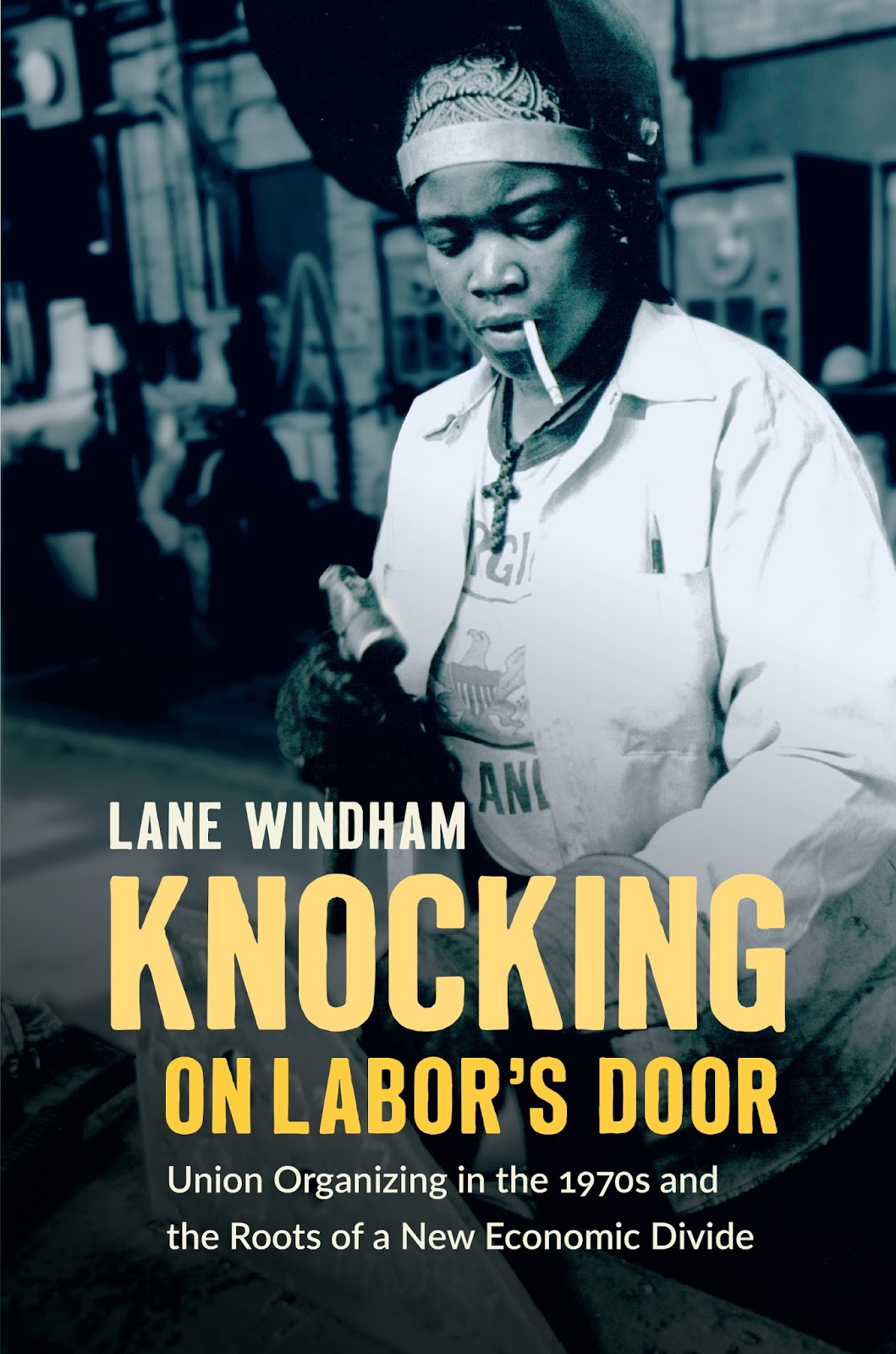
Three months ago today, I launched my new book, Knocking on Labor's Door: Union Organizing in the 1970s and the Roots of a New Economic Divide.

The book overturns myths that workers turned away from unions and that unions stopped reaching out and organizing during the 1970s, a pivotal decade. Instead, as women and people of color gained new access to the full job market after the 1964 Civil Rights Act, they began demanding unions. Young workers, especially black workers and women, powered an unseen wave of union organizing in the 1970s that has been overlooked by historians and journalists. Employers, however, united to manipulate weak labor law and quash the new surge of worker organizing.


Here I've gathered links to the "greatest hits" from my various podcasts, interviews, and articles that focus on Knocking on Labor's Door:

Today's article in Working-Class Perspectives on sexual harassment: #MeToo Solidarity

My article in the Washington Post: The Media Still Gets the Working Class Wrong, but Not in the Way You Think

Q&A with Justin Miller in The American Prospect: The New Workers, and New Militancy, of the 1970s

Who Makes Sense podcast:

Working History podcast episode

My blog post for LAWCHA: Labor and Working-Class History Association

Excerpt in Social Policy magazine on 9to5

And check on the dedicated Facebook page

The book is available through the UNC Press site, on Amazon, through The Regulator bookshop (awesome independent book store in Durham, NC), through Powell Books, and at other book stores.

Tuesday, September 5, 2017

Getting the Working Class Right

The below Washington Post piece ran just as my new book launched on Labor Day: Knocking on Labor's Door: Union Organizing in the 1970s and the Roots of a New Economic Divide Check the book out here.


The Media Still Gets the Working Class Wrong

by Lane Windham

This will be the first Labor Day since America rediscovered its working class – or, more accurately, one part of its working class. If there was any consensus in the aftermath of last November's election, it was that elites had lost touch with working people. Yet ten months later, most commentators still get the working class wrong.

We hear a lot from pundits about working-class white men, conjuring images of blue collars, hard hats and simmering resentments expressed through votes for Donald Trump.

But in reality, America’s working class is largely female and disproportionately black and brown. Service jobs now outstrip those in manufacturing; the jobs with the highest-projected job growth are typically woman-dominated working-class jobs like nursing, home health care and food service. Significantly, the majority of members of the working class do not see President Trump as their defender.

Post-election analysis overlooked both the complexity and creative energy of the nation's working class. Increasingly, working people are organizing a new kind of workers' movement that combines traditional unions with organizations that build worker power beyond the weakened collective bargaining system.

In fact, we may stand on the cusp of a new surge of worker activism unlike any the U.S. has witnessed since the 1970s. Historians have missed that pivotal decade's working-class promise, instead painting it as an era of division and defeat. School busing riots seize center stage in their tale, as do highly visible male construction workers beating up Vietnam War protestors.

This story isn't wholly wrong, but it's incomplete. The focus on a hard-hatted "silent majority" obscures the millions of workers who were part of a newly diversified working class in the 1970s and who actively organized unions. How we understand working people and their politics, both in the past and today, matters deeply for how we perceive the causes and solutions for the nation's economic divide.

White men haven't been the epicenter of the working class since the 1960s. Following the 1964 Civil Rights Act, women and people of color finally gained more access to jobs at the economy's core. Once this diverse group of workers got those jobs, they demanded unions. A half-million working people per year voted in private-sector union elections in the 1970s, pushing for the full economic security that came with a labor contract.
Employers, however, manipulated aging and outdated labor laws to thwart their efforts. Even unionized industrial employers began to resist new organizing in the 1970s, backed by a vastly expanded anti-union consultant industry.

Globalization and mechanization eroded union membership, but so too did the fact that workers couldn't win union representation over employer opposition. In the 1940s, workers won 80 percent of their union elections. By the late 1970s, employers had the advantage, winning more than half of these elections and blocking workers' access to collective bargaining, a key economic equalizer. Union membership has since continued to slide — a mere 6.4 percent of private-sector workers today have a union.

As unions declined, so did our nation's democracy. After all, organized labor devotes tremendous energy and resources to getting voters to the polls. Groundbreaking research by sociologist Jake Rosenfeld reveals that since 1984, election-day turnout among private-sector union members without a college degree has been seven to eleven points higher than that of similar workers who aren’t union members.

Unions also educate their members on economic and political issues, and so counterbalance the temptation among workers to let divisive cultural issues determine their votes. That is especially true among white union members, who tend to vote more conservatively than do union members as a whole. Far fewer working people today are privy to these kinds of workplace conversations than in unions' heyday.

Unions’ shrinkage also fed the nation’s growing economic divide. Researchers find that between one-fifth and one-third of wage inequality is due to the drop in union membership since the 1970s.

Today’s key working-class concern isn't whether Trump saved a few manufacturing jobs in Indiana. The most burning question seems to be off his radar entirely: how can the majority of working people build better lives when jobs are so bad and unions are so weak?

Part-time, poorly-paid jobs are the new norm, especially in the service and retail sector. Workers often find that they are legally considered independent contractors — and therefore unprotected by labor laws — even when they drive the same truck route each day, or sweep the same office floors. Also excluded from labor law protection are the millions in the gig economy. And when “protected” workers try to form unions, employers routinely fire, harass or threaten them.

Yet despite these challenges, America's diverse working class is even now building a new workers' movement, often far outside the media spotlight. It’s different from the twentieth-century labor movement, which consisted of traditional unions alone. Workers today are blending unions with new organizations that experiment with innovative ways to circumnavigate the nation’s broken labor law system.

Women and immigrants lead these worker centers, public wage campaigns and occupation-based organizations, such as the National Domestic Workers Alliance, the Restaurant Opportunities Centers United and the New York Taxi Workers Alliance. Such groups make creative use of public opinion, wage and hour laws and tried-and-true community organizing tactics to rebuild workers' economic security, even within the changed twenty-first-century workplace. Without ever engaging in collective bargaining, New York restaurant workers have used this array of tactics to win sick days, and Massachusetts domestic workers have won a “bill of rights” guaranteeing overtime pay and fair treatment.

Workers still want unions. Witness the upsurge of unionism on university campuses where adjunct faculty, graduate employees and food service workers are all demanding their right to bargain collectively.

Working people also are pioneering entirely new ways to raise wages and win benefits, often leveraging the power of local government. Sixteen states and localities have approved raising the minimum wage to $15 an hour since 2013. San Francisco, Seattle and New York City have all enacted fair scheduling rules to protect certain workers from erratic shifts and insufficient hours. Unions, worker centers and community groups have banded together to buoy these wins.

Much depends on the success of such experiments. In the twentieth century, we learned that healthy democracies require economically secure citizens. For a generation, we have witnessed the erosion of both. This Labor Day, working women and men are increasingly fighting to reestablish a basic economic foothold. Yet their struggle will remain largely invisible to us as long as we fail to see today’s working class in all of its diversity.

Wednesday, March 29, 2017

From Pink Collars to Pink Hats: Working-Class Feminism and the Resistance

By Lane Windham


Photo from Women Firefighters Contingent to the Women's March on Washington

Tightly gripping a “Firefighters for Women’s Rights and Equality” banner at the Women’s March on Washington, a group of women who had once made history as New York City's first female firefighters roared up Independence Avenue. There, they joined a new generation of labor activists: teachers, nurses, government workers, restaurant servers, home health-care aides, communications workers, and thousands of other working-class women and men who turned out to protest Donald Trump’s inauguration in what was perhaps the largest global political mobilization in history. Women have continued to march, huddle, strike, and organize against Trump since January, among them legions of young women workers. Is it possible that women—including working-class women—can generate a powerful-enough grassroots movement to overcome Trump?

It’s not immediately obvious that a new women’s movement will spell the Donald’s downfall. The corporatized feminism featured in the popular media seems a particularly poor basis for opposition. If Dove soap, Facebook executive Sheryl Sandberg, and Ivanka Trump are our modern-day feminist icons, there is little hope that the women’s movement can be a cross-class organizing tool. Even many progressives doubt the power of women’s issues to transform the political moment; some branded the call for women to strike on March 8 as elitist, for example.


Feminism too often gets a rarified label; it’s considered the property of elite women with their eyes on glass ceilings. Yet working-class feminists have long been potent champions for women’s advancement, and 1970s second-wave feminism had deep cross-class roots. The late-night huddle in Betty Friedan’s hotel room that first sparked the National Organization of Women (NOW) included a number of union activists, among them Caroline Davis and Dorothy Haener of the United Auto Workers and Catherine Conroy of the Communications Workers of America. NOW’s founders were fed up with the new Equal Employment Opportunity Commission’s refusal to target gender job discrimination while enforcing Title VII of the 1964 Civil Rights Act. Working women activists formed more than a dozen organizations to improve “pink collar” office work in the 1970s. Women Employed in Chicago and 9to5 in Boston upended cultural expectations that secretaries should pamper and fetch coffee for their male bosses. Women like those roaring NYC firefighters fought their way into all-male blue-collar enclaves in the 1970s and 1980s, filing lawsuits and demanding respect.


Today, women once again lead a wave of labor and class-based organizations, and together these groups make up a new iteration of working-class feminism. Women are at the forefront of “alt-labor” groups like the Restaurant Opportunity Centers, the National Domestic Workers Alliance, and the National Taxi Workers’ Alliance, and all brought troops to the Women’s March on Washington. Women are key activists in traditional unions, too. Three of nation’s largest unions—the American Federation of Teachers, the National Education Association, and the Service Employees International Union—have female presidents, and women will make up a majority of U.S. union members by the year 2023. Women are far more likely than men to hold the sorts of part-time and contingent McJobs that are becoming the economy’s norm, and they are fighting back from the helm of the Fight for 15 campaign. The Black Lives Matter movement’s analysis includes a savvy mix of class and race; its three founders are all women. In fact, Black Lives Matter activists will demonstrate alongside workers leading Fight for 15 on April 4, the anniversary of Martin Luther King Jr.’s death. Young women also power much of the immigrant workers’ rights movement, yet no one thought to label the recent Day Without Immigrants strike as elitist.

A big difference between the working-class feminism of the 1970s and that of the 2010s has to do with the economy. When those firefighters and pink-collar secretaries fought for inclusion 40 years ago, they demanded access to an economy marked by broad prosperity. Working people’s share of the pie had been steadily growing for decades, and they saw no reason why that wouldn’t continue. Since that time, working people’s prospects have dimmed and their wages have stagnated; the United States has largely traded manufacturing jobs for low-paid, contingent service jobs.

Women constitute four out of ten breadwinners in American families, yet they still make far less than men and hold the worst jobs in the emerging precarious economy.
Today’s working-class feminists must fight not only for economic inclusion, then, but also for economic transformation, demanding an economy that works for all. Women constitute four out of ten breadwinners in American families, yet they still make far less than men and hold the worst jobs in the emerging precarious economy. Working women’s top concerns include good family leave, a decent wage, fair scheduling, and paid sick leave, and all these are potential wedge issues that could break apart Trump’s blue-collar coalition.

After all, many working-class women voted for Trump. While the majority of females voted for Clinton, a full 61 percent of white women without a college degree walked into a voting booth and filled in a bubble beside the name of a man who bragged about grabbing women’s genitals without consent. The breadth of white working-class women’s support for Trump was one of the many 2016 election shocks that a flawed polling system failed to predict. While analysts will long debate these voters’ thinking, it’s clear that many of these women share the sense of dislocation and despair that drove white, blue-collar men’s votes. Common-sense economic solutions for working women will be key to turning around those votes for progressive candidates in 2020 and beyond.

That’s why the robust working-class feminism bubbling up among women, particularly young women workers and women of color, holds the power to reshape the nation’s economic and political landscape. Young women are leading the most exciting and dynamic aspects of the 21st-century progressive movement, and they’ve been at this for a while now—well before the sea of pink pussy hats riveted the world’s attention. Progressives who seek to oust Trump should nurture and support today’s intersectional working-class feminism; far from elitist, it speaks for so many Americans that it may provide the key to long-lasting change.

You can find the piece at the American Prospect here

Thursday, September 1, 2016

Best Read for Labor Day 2016

Lane Windham

Best Read for Labor Day 2016: Tamara Draut's Sleeping Giant: How the New Working Class Will Transform America (Doubleday, 2016)


Like me, are you bone weary of hearing non-stop news coverage of Donald Trump? Do you roll your eyes when the pundits “discover” the working class at election time, and then groan when you realize that by “working class” they really only mean white guys? Are you itching for an entirely different public conversation?

Tamara Draut’s Sleeping Giant offers a sharp and widely-accessible discussion about the future of America’s working class, and so brings welcome relief in this election season. Her premise is that there is a “new” working class, compared to that of thirty years ago, that is more racially and ethnically diverse, more female and more likely to work in retail and service. Pointing to the Fight for $15 and the Black Lives Matter movement, for example, Draut posits that this “sleeping giant” may be in the beginning of effecting larger social and economic change.

In a swift and conversational style, Sleeping Giant distills much of the current research on inequality, bad jobs, and precarious work, and couples it with original interviews with workers and activists. We learn, for instance, that only five of the thirty fastest-growing U.S. occupations will require a bachelor’s degree; so much for the elite’s insistence that education will be the great leveler. The chapter on the “New Indignity of Work” could serve as an undergraduate primer for perils in today’s economy such as subcontracting, just in time scheduling, franchises and the “1099” independent contractor relationship.

Unlike many in the punditry class, Draut has read her history, and we see the work of Nelson Lichtenstein, Kim Phillips-Fein, and Judith Stein woven in here as she traces how America’s working people became so economically insecure. She tackles the legacy of racial and ethnic exclusion, and correctly finds great hope in the combination of the immigrant workers’ rights, fair wage and racial justice movements of today.

Yet in Draut’s insistence that today’s is a “new” working class with a new level of activism, she ultimately may do the “sleeping giant” a disservice. First, such a framing erases the extent to which people of color and women have long struggled and organized as part of the working class, as wage workers, enslaved people, and through their neighborhoods and families. In the long arc of history, mid-twentieth century steelworkers were anything but normative. Fight for $15 activists are part of a centuries-long struggle against capitalism, and they should benefit from owning that.

Second, Draut misses the major working-class activism of the 1970s. What we are seeing today is not a “new” working class, but a continued reconfiguration of the working class that started in the 1970s and grew from changes wrought by the 1964 Civil Rights Act. As these women of all backgrounds and men of color got new access to the full employment market in the 1970s, they made up a reshaped American working class that organized for more social and economic justice, including by pushing to form private sector unions. Draut covers how employers ramped up their resistance to unions in the 1970s, but somehow skips the decade’s worker’s movements that inspired the corporate resistance. When we re-write the 1970s struggles back into the story, it becomes more clear that today’s labor activists are part of a much longer movement by women and people of color to gain full access to the New Deal’s economic promise, a story that grows more even more rich with the inclusion of new immigrants since 1980.

Despite these omissions, this is a commendable and inspiring book that covers an enormous amount of material in a short space. Do yourself a favor this Labor Day: put down the Washington Post and pick up a copy of Draut’s Sleeping Giant.

Lane Windham holds a Ph.D. in U.S. History and is a fellow with Georgetown University's Kalmanovitz Initiative for Labor and the Working Poor.

Wednesday, November 5, 2014

Make 2016 About Minimum Wage Ballot Initiatives

2014 Election Analysis:

Make 2016 About Minimum Wage Ballot Initiatives

Lane Windham

Democrats and progressives can take one key lesson away from the 2014 Republicans’ rout: Americans want a raise, and will vote for minimum wage ballot initiatives even in red-leaning states. Minimum wage increases passed in Arkansas, Nebraska, South Dakota and Alaska - - even as voters in each of these states also elected a Republican senator.

A whopping 67 percent of Alaskans voted to increase the minimum wage to $9.75 by 2016 - - yes, that’s Sarah Palin’s state. Voters in the Deep South’s Arkansas voted 65 percent for a minimum wage increase, and in Nebraska 59 percent of voters chose to up the minimum.

What’s going on here? After all, Democrats support a minimum wage. President Obama has been pushing for a $10.10 minimum. So why are voters turning down the candidates who support a raise, while voting for the raise itself?

People are still struggling economically – not only in the U.S., but around the world. They need their elected leaders to have big, bold plans for shared prosperity in an age in which new economic structures mean fewer jobs and more inequality. As Harold Meyerson writes in some of the most insightful election analysis out there, the Democrats find themselves in the same quandary as center left parties throughout the world. They are “parties that purport to be the economic advocates of the middle and working classes, but preside over abysmal economies with no clear sense of how to make them better.” We need a new social compact, and tinkering around the edges won’t do it.

It turns out that when the gods who run elections gave voters a chance to vote for good economic policy, they grabbed that chance. Voters essentially went underneath political parties who they perceive as not serving their economic needs.

So let’s give voters even more opportunities to vote for a minimum wage. Let’s make 2016 the year of the minimum wage ballot initiative. (After all, there is now virtually no chance of Congress raising it on a federal level any time soon.) A nationwide push for minimum wage ballot initiatives will not only give working people a much-needed raise, but will serve to bring out the young people, people of color and working-class voters the Democrats will need to win office. If Democrats offer a more robust economic plan, many of those ballot voters may stick with the party.

Some states, like North Carolina, don’t allow statewide ballot initiatives. There, both houses must vote by a super majority to refer a constitutional amendment. So, go local. Cities like Raleigh and Greensboro both can pass their own referendums - - and both are cities with the sorts of voters Democrats need to turn out.

Democrats still need a big economic vision, and minimum wage ballot initiatives aren’t a full platform. Yet such initiatives do seem to be a tool that America’s voters will support - - even those who are seeing red.


Wednesday, February 12, 2014

VW Chattanooga Vote: It's Historic, But Not a First

by Lane Windham

I put the VW Chattanooga Vote into a 40-year historical context in my new article on the Institute for Southern Studies' Facing South: VW Workers Not First to Face Choice on Union I was inspired to write this piece because a number of reporters have written the story without fully grasping how long Southern auto workers have been trying - - and even sometimes succeeding - - at forming unions.

Sunday, February 3, 2013

If not unions, then what?


If not unions, then what?

Opinion Editorial in Baltimore Sun:


Membership in organized labor, a tremendous force for ensuring broad prosperity, is at a 93-year low

January 28, 2013| By Lane Windham

You wouldn't know it from our nation's debate over Obamacare, but the U.S. has had government-supported health care for nearly 80 years. Not only that, but our nation bolsters a retirement level well beyond the thin safety net provided by Social Security, and it even ensures Americans a path to a family-supporting wage. And, no, I have not mistaken the U.S. for a socialist European nation.

Our government assures us these broad economic benefits by guaranteeing our right to form a labor union. Those among us who join a union — or who get a job with a company that matches the higher wages and benefits offered by its unionized competitors — effectively win a more robust social safety net through government-sanctioned collective bargaining. Thus, the U.S. has long relied on unions to do the kind of economic redistribution work which is shouldered by governments in other nations.

However, our nation is about to lose this leveling tool. We learned this month that the nation's rate of unionization is at a 93-year low. Only 11.3 percent of America's workers belong to a union, including a mere 6.6 percent of private-sector workers. In Maryland, union membership used to be above the national average, but in 2012 it fell below average to 10.6 percent. Much of the media coverage around this drop in union membership asks what this means for labor's future. The larger question, however, is what it means for America's future — how will our nation temper the inequities of today's new, global economy if we can no longer rely on unions to do that work for us?

Unions have long served as economic equalizers. From 1947 to 1972, the U.S. economy was the undisputed economic world leader, and our nation used unions to ensure that we spread that wealth around. Once union membership started falling, the income divide grew. Since 1973 the drop in union membership accounts for a full third of the growth of wage inequality among men, according to a recent study by scholars at Harvard and the University of Washington. Today, the income gap is larger than anything we've seen since before the Great Depression.

In fact, it was during the Great Depression that our nation struck a grand compromise to finally soften for its citizens the harshness of industrial capitalism. It was a bargain that had been in the works since the late 19th century, and we hammered out the details throughout the post-World War II period. America's citizens never got the kinds of universal health care programs, job insurance or wage guarantees that benefited European workers. Instead, we won very basic economic security through Social Security and, eventually, Medicare. Plus we won the government's assurance that if we voted in a union election, the government would give legal backing to our efforts to win greater economic security from our employers.

However, too few of us were ever able to grab onto this economic life boat. It turns out that it is difficult to form a union, and employers have shrewdly upped their resistance over the decades. Employers routinely fire, harass and threaten workers who want to form unions, and U.S. labor law is too weak to stop them, according to Kate Bronfenbrenner at Cornell University. In fact, in 2000 Human Rights Watch declared that U.S. workers have effectively lost the freedom to form a union. However, labor law reform does not seem to be in the Obama administration forecast for the second term.

So, if not unions, then what's the new plan? What's the new institutional framework we will use to balance people's needs with those of corporations? If we're going to effectively scrap our nation's method of broad economic redistribution, what will we replace it with? A near 100-year low in unionization rates isn't just labor's problem. It's a problem for anyone who does not want to see U.S. economic inequality shred our nation's social fabric.

Lane Windham is a PhD candidate in U.S. History at the University of Maryland, College Park. Her email is lanewindham@gmail.com.

http://articles.baltimoresun.com/2013-01-28/news/bs-ed-unions-20130128_1_union-membership-labor-union-income-gap